When the org chart becomes an architecture decision


Jack Dorsey and Roelof Botha recently argued that corporate hierarchy was never a management philosophy but a workaround. A single leader can coordinate only three to eight people, so organizations added layers to move information up and down a chain of command. On this reading, every structure from the Roman legion to the McKinsey matrix has solved the same problem - coordination under a fixed human bottleneck - with the same instrument. The claim is that a system can now maintain a continuously updated model of an entire business and coordinate work across it, making the routing layer obsolete. Block is reorganizing around exactly this logic, replacing the pyramid with three roles: people who build, people who own specific outcomes, and player-coaches who develop others while staying close to the work.
The argument is clean, and the historical framing is largely correct. The interesting question is whether the proposed replacement holds under the conditions of an ordinary enterprise?
The assumption that carries the whole thesis
Everything rests on one claim:
The coordinating context, managers used to carry, can be relocated into a system.
Block calls this a company world model, built continuously from machine-readable artifacts - decisions, code, plans, progress - because the company is remote-first and records almost everything by default. Where work already exists as structured signal, an AI can plausibly maintain a live picture of what is being built, what is blocked, and where resources sit. Block pairs this with a customer world model fed by transaction data, on the reasonable premise that money is a more honest signal than surveys or clicks.
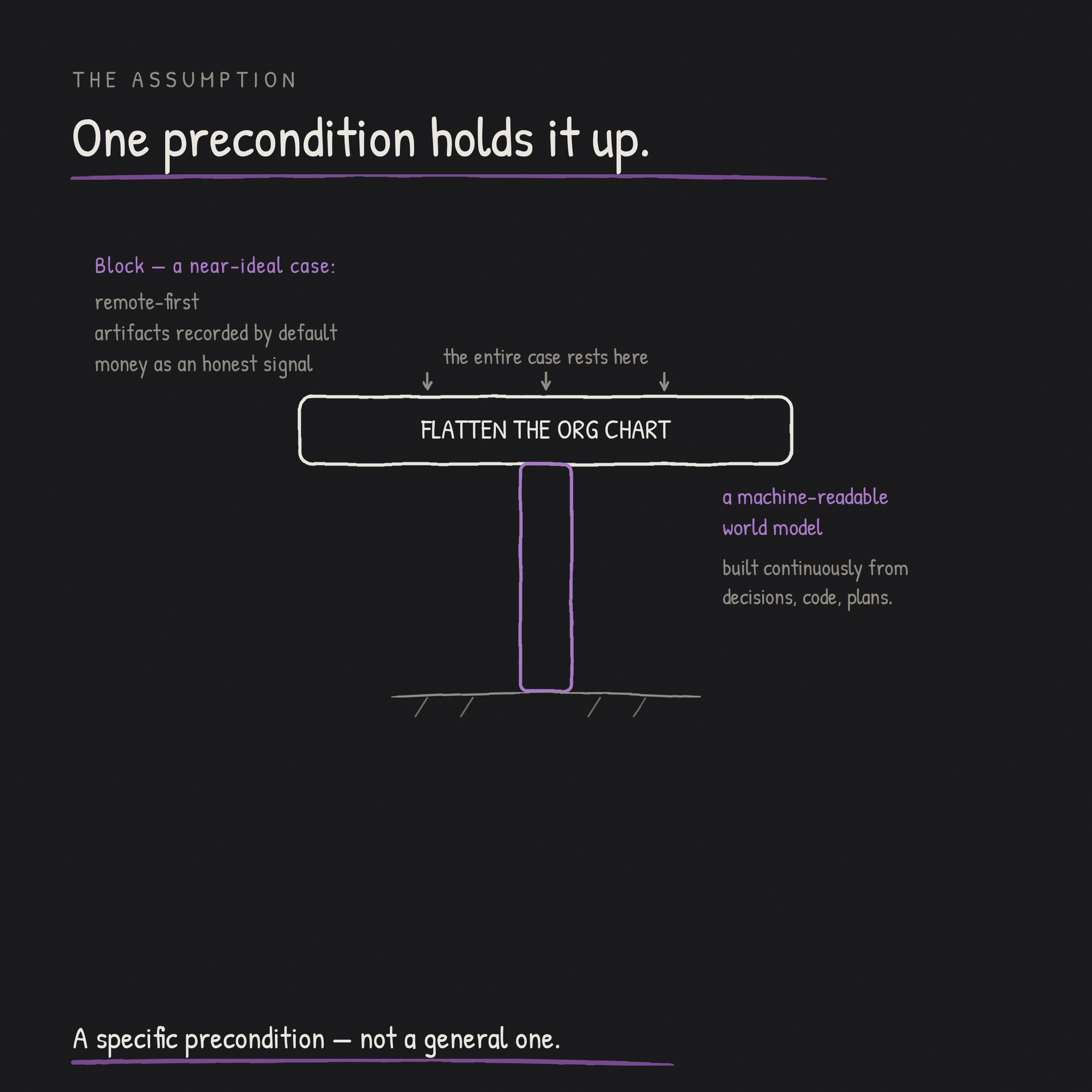
These are specific preconditions, not general ones. They are also where most enterprises diverge from the example.
Why the context does not transfer cleanly
In a typical enterprise landscape, the model of the business is exactly the artifact that has never existed in usable form. Systems of record are fragmented across ERP, CRM, ticketing, and a long tail of spreadsheets and shadow tools. The same entity - a customer, a product, an order - carries different identifiers and incompatible semantics in each. RAG over that estate retrieves inconsistency at scale, and no context window is large enough to reconcile meaning that was never agreed in the first place. The hard part of an enterprise data model is about semantics, ownership, and trust.
There is a second problem the routing metaphor understates. Middle managers do not only relay information. They absorb exceptions, resolve ambiguity, and carry tacit knowledge that lives in no repository: who to call, which policy is actually enforced, why a given process quietly deviates from its documentation.
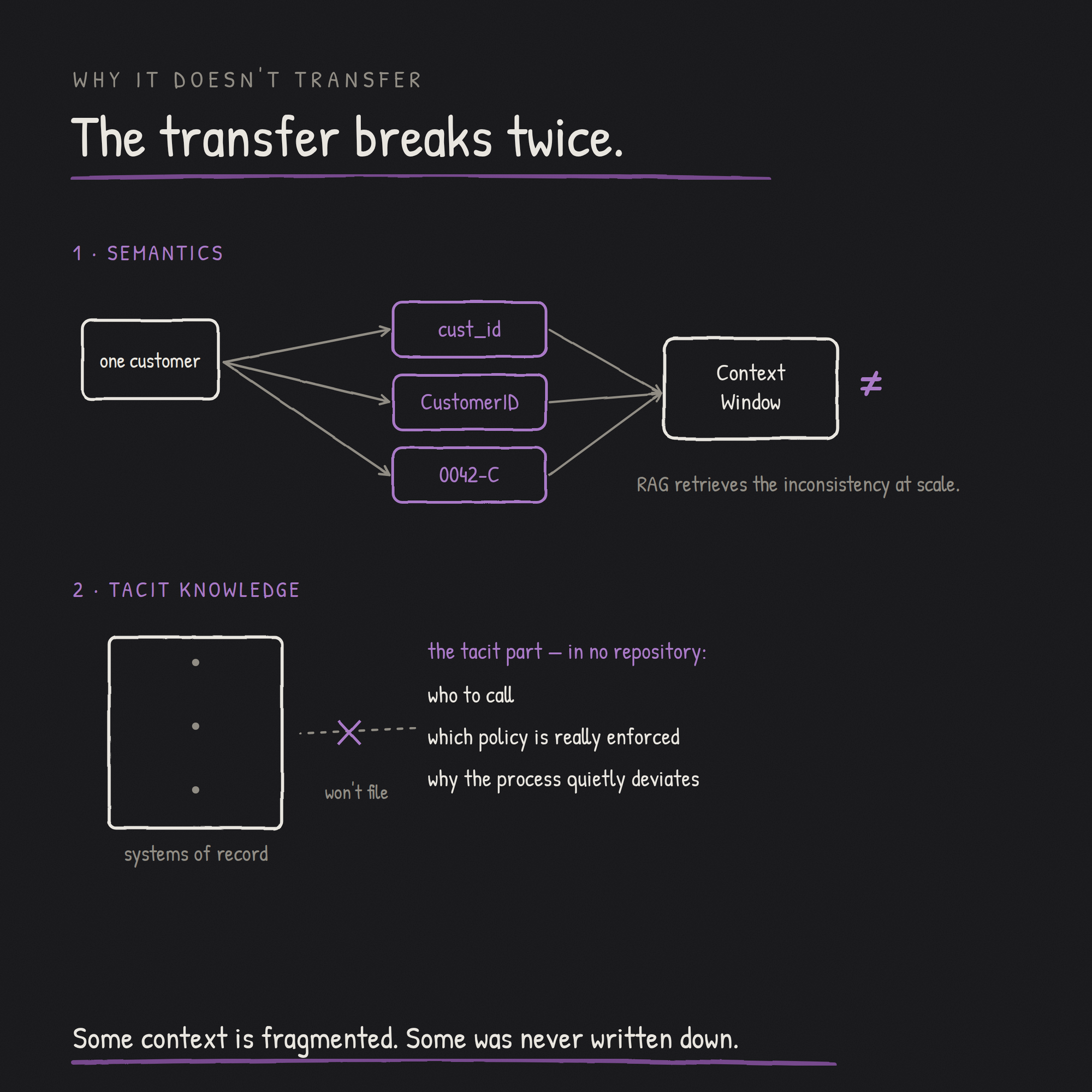
Relocating coordination into a system assumes this context is legible and reasonably complete. In most organizations it is neither, and the gap tends to surface precisely at the moments that matter most.
The economic and governance dimension
Even where the technical preconditions hold, the operating model shifts risk rather than removing it. A system that composes actions across capabilities through tool calling - issuing a loan, adjusting a repayment schedule, moving money - is exercising authority that previously sat with an accountable human. That authority needs boundaries, audit trails, and reversibility. The cost of a wrong decision does not disappear when a manager leaves the loop; it migrates into architecture and governance, where it is easier to overlook and harder to attribute after the fact.
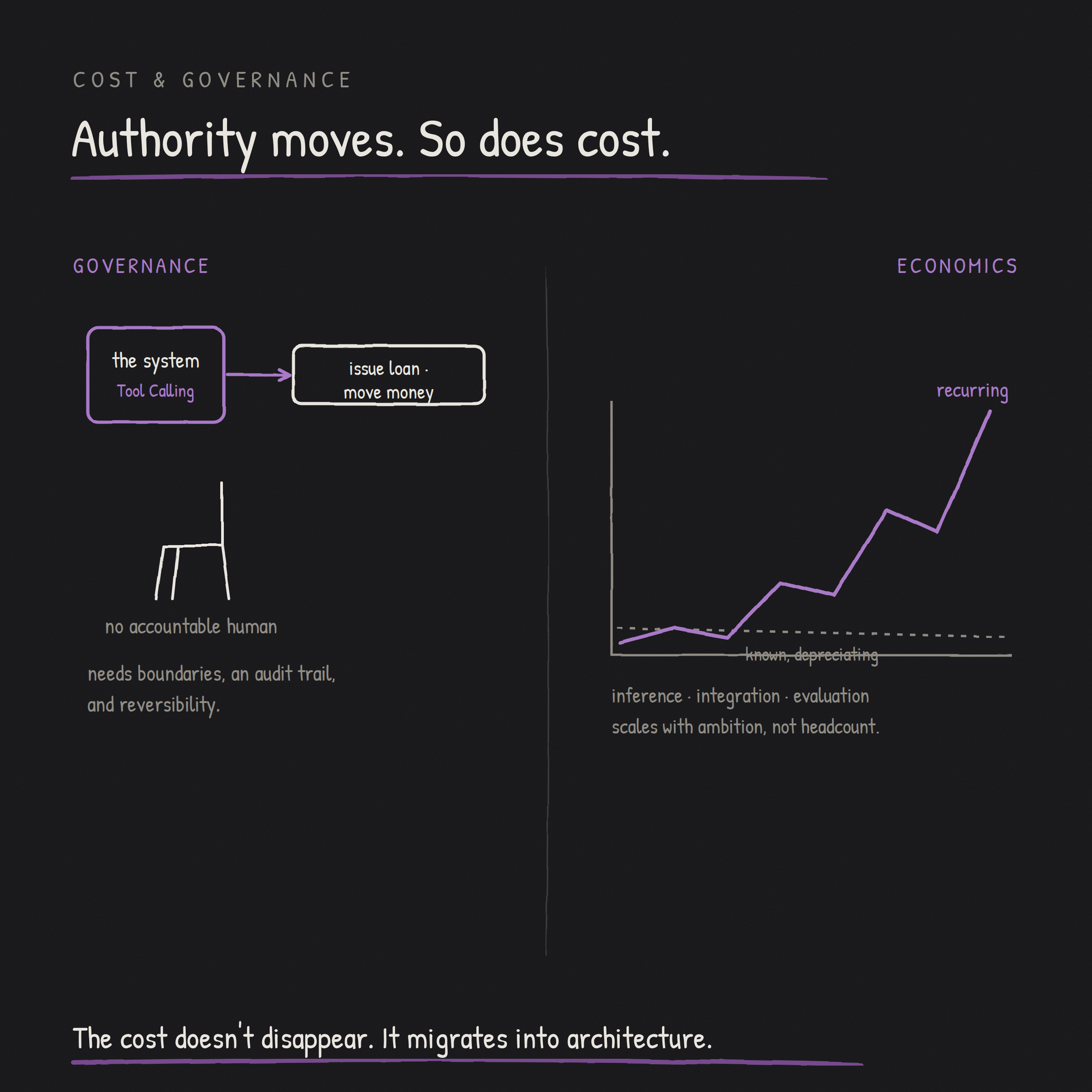
The economics deserve equal sobriety. Maintaining a continuously updated world model is not a one-time build. Inference, integration, data-quality remediation, and evaluation are recurring costs, and they scale with ambition rather than with headcount. For many organizations the honest comparison is not a leaner structure against a heavier one, but a new and volatile cost base against a known and depreciating one.
The question underneath the reorganization
Dorsey and Botha close with the question that actually matters, and it is worth restating in architectural terms: does your organization understand something genuinely hard to understand, and is that understanding deepening over time? If not, AI here is a cost-reduction story - fewer people doing the same work, with margins that improve for a while and then compress.
If the answer is yes, the calculus changes. The value lives in the model of reality the company maintains, and org structure becomes downstream of information architecture rather than of reporting convenience. That reframing is defensible. It also raises the bar considerably. A company world model is only as good as the data foundations, semantic discipline, and governance beneath it, and those are precisely the areas most enterprises have historically underfunded.
The decision, then, is not whether to flatten the org chart. It is whether the underlying system landscape can carry the context a hierarchy currently carries - and what it would concretely take to make that true. For most organizations that is an architecture programme measured in years, not a reorganization announced in a memo. The org chart may well become a strategic question. It becomes one through the data model, not around it.
This blog post draws on concepts from From Hierarchy to Intelligence by Jack Dorsey and Roelof Botha, published on Block webpage.
My content is carefully prepared, crafted and takes anywhere from a few days to several weeks. I sacrifice my free time to create high quality content for you.
The easiest way you can support ♥️ me? Subscribe, like and share this article.
If you like to know more about me, please contact me directly or visit my LinkedIn profile.