AI - Why Architecture matters more than ever.

How do we automate Architecture efforts with AI?
Is this really the right question to ask?
It sounds logical, but it rarely leads to the highest return on investment. The better question to ask is:
What are architectural preconditions for AI agents to function reliably, economically, and at scale?
There is a growing assumption that the need to clean up enterprise IT landscapes will diminish as AI systems become more capable. Agent-based AI promises to work with unstructured data, undocumented interfaces, and heterogeneous legacy environments.
If intelligent agents can navigate chaos, why invest in order?
This assumption does not hold under closer technical, architectural, and economic considerations. Not everything needs to be modernized. But the right things must be. Enterprise Architecture becomes the vehicle that decides where investment is mandatory and where technical debt can remain tolerated.
The illusion of autonomous agents

Agents understand natural language, orchestrate workflows across systems, and solve problems autonomously. In controlled demonstrations, an agent retrieves information from multiple systems and produces coherent outcomes with minimal configuration.
The implicit conclusion is seductive: if agents are intelligent enough, the underlying architecture becomes secondary.
What these narratives hide is the difference between a demo environment and a production enterprise landscape. Under the surface of every AI initiative sit legacy systems, fragmented data models, undocumented integration logic, and accumulated operational shortcuts. The question is not whether an AI agent can technically operate in such an environment, but under which conditions it does so predictably, cost-efficiently, and in a way that is in line with governance and compliance.
Answering that question requires an understanding of the concrete limitations of today's AI capabilities.
Context window constraints - why structure still matters
Large Language Models operate within a bounded context window. Depending on the model, this ranges from several thousand to a few hundred thousand tokens. While this appears generous, it is quickly exhausted in enterprise scenarios.
Business documents, API responses, historical records, and conversational state all compete for limited context capacity. When an agent aggregates information from multiple poorly structured systems, the context fills up before any meaningful reasoning begins.
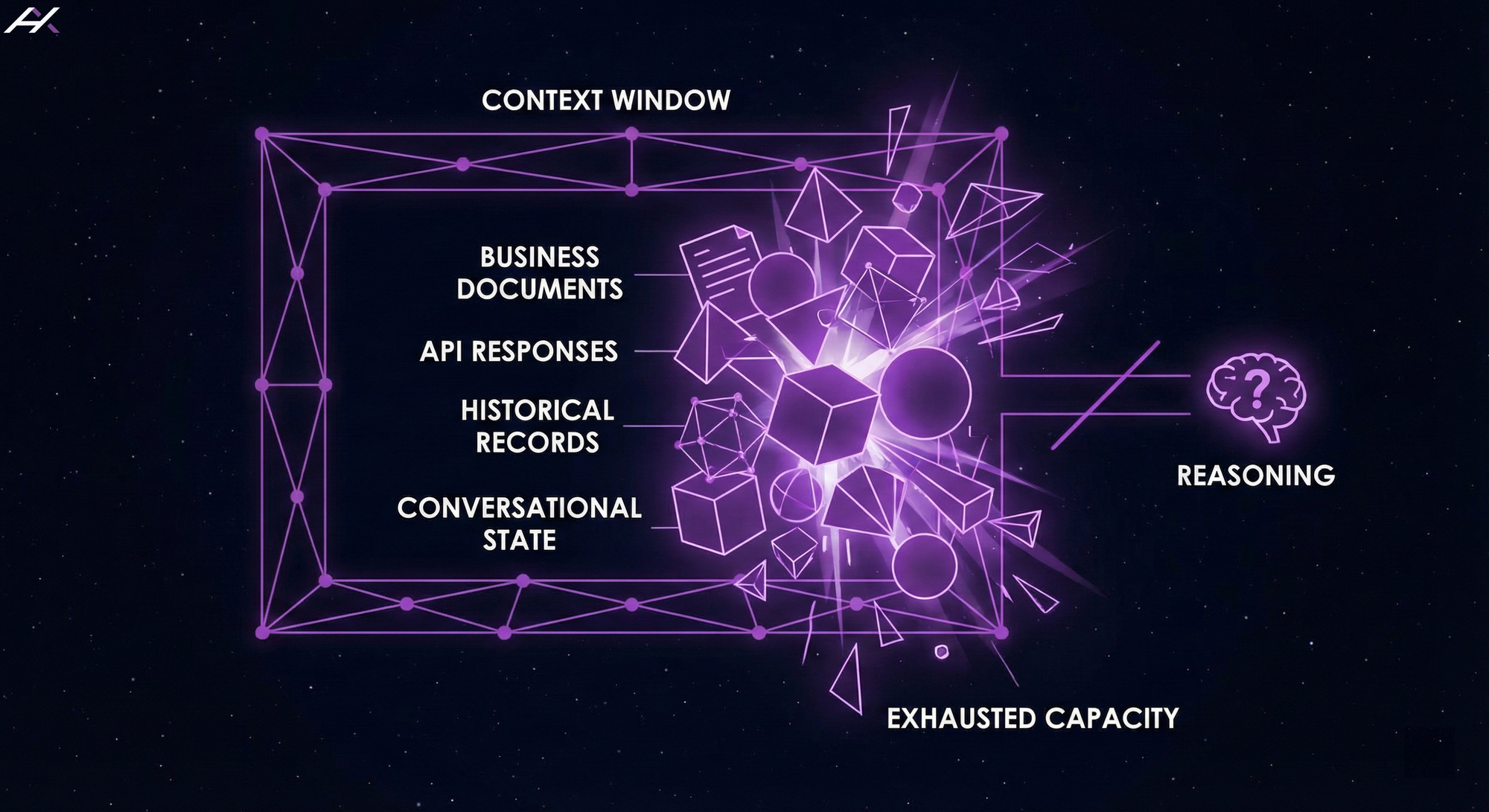
RAG (Retrieval Augmented Generation) can mitigate this problem, but only if the underlying data is semantically indexed, and accessible in a predictable way. Larger context windows do not eliminate the issue; they amplify the cost and increase the probability of degraded reasoning as irrelevant or redundant information accumulates.
For enterprise architecture, the implication is straightforward: unstructured abundance is not an asset. Context is a scarce resource. Applications that expose concise, well-scoped, and semantically coherent data reduce both, operational cost and reasoning risk.
Hallucination risk and the cost of inconsistency
AI systems generate outputs that are plausible, not guaranteed to be correct. When inputs are inconsistent or contradictory, the probability of hallucination increases sharply.
In many enterprises, the same business fact exists in multiple systems with subtle variations. Contract dates, customer statuses, or entitlement rules may differ depending on the source. A human user recognizes these discrepancies through experience. An AI agent does not. It selects one version and proceeds with confidence.
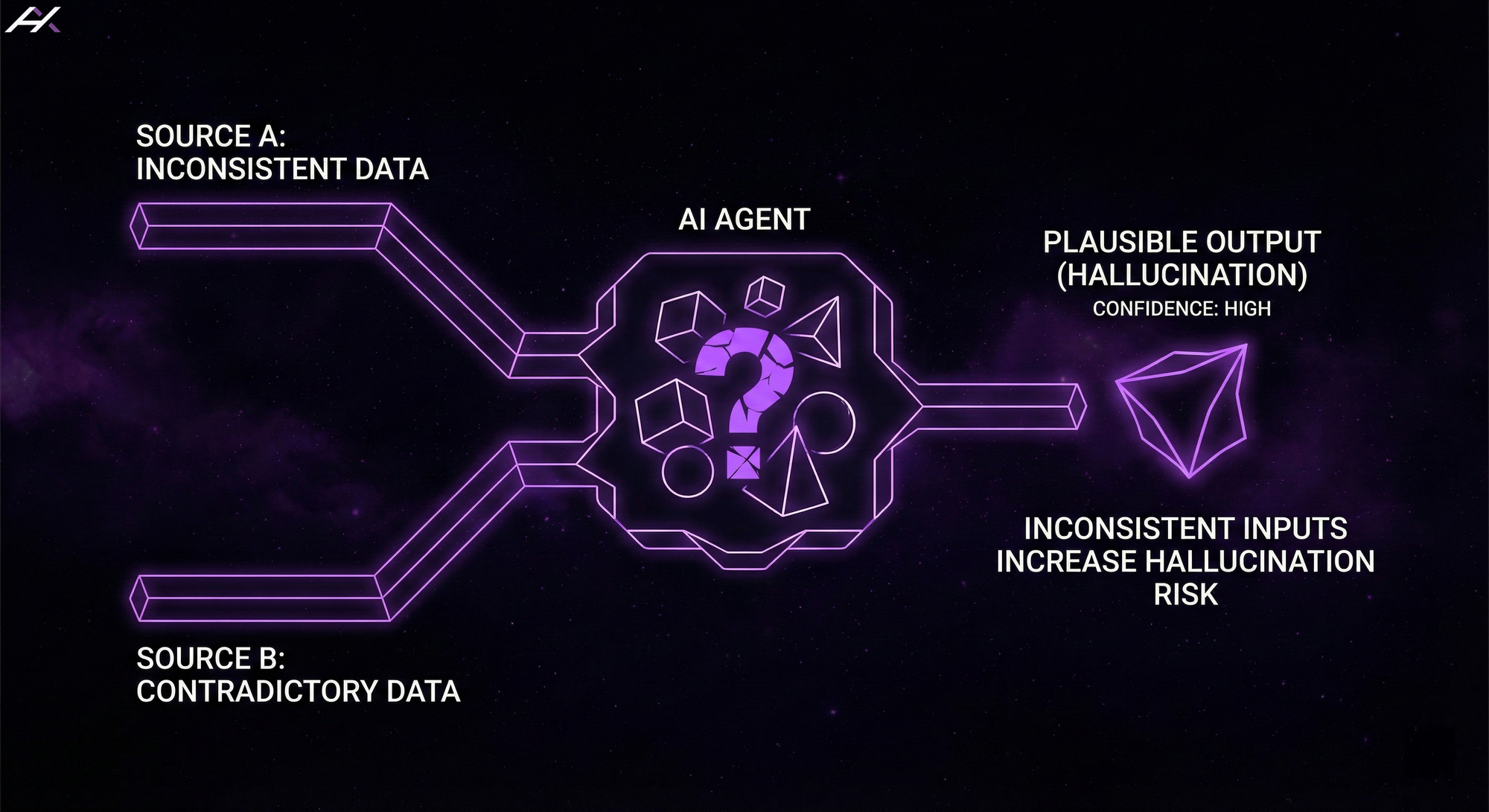
This is not a theoretical problem. In use cases where AI agents support or prepare business decisions, inconsistent data becomes a direct risk factor. Single Sources of Truth are therefore not an academic ideal, but a practical necessity for any AI-enabled decision flow.
Importantly, this does not require replacing all legacy systems. It requires explicit architectural decisions about data ownership, authoritative sources, and governance enforcement. Enterprise Architecture is the discipline that makes these decisions visible and enforceable.
Tool calling and the reality of enterprise integration
AI agents interact with applications through API calls. This mechanism assumes well-defined functions, stable parameters, and predictable responses. Modern REST APIs fit this model well. Batch interfaces, proprietary protocols, undocumented side effects, and implicit defaults do not.
In most enterprises, critical applications were not designed for real-time, fine-grained interaction. Mainframe transactions, file-based exchanges, and tightly coupled application logic remain common. AI agents cannot reason reliably about such interfaces.
The architectural implication is not a wholesale replacement of legacy applications, but targeted encapsulation. Applications that are relevant for AI-driven workflows require explicit API façades that make behavior, constraints, and errors visible. Systems that are irrelevant for AI use cases do not. Again, differentiation is the core task.
Latency, cost, and the economics of reasoning

Agent-based workflows multiply these interactions through planning, execution, validation, and error handling steps.
In a fragmented architecture, an agent must navigate ambiguity. It makes more calls, retries more often, and consumes more context. Operational costs rise accordingly. What appears as a minor architectural inefficiency becomes a recurring expense at scale.
A cleaner architecture does not merely improve elegance. It reduces reasoning depth, minimizes retries, and lowers per-transaction cost. Architecture quality directly influences the economic viability of AI use cases.
Failure modes and undocumented behavior
Legacy systems often exhibit undocumented behavior. Default values, silent error handling, and implicit corrections may be well understood by long-tenured staff but are invisible to automated agents.
For AI systems, such behavior is indistinguishable from correct output. This creates failure modes that are difficult to detect and harder to audit.
The architectural response is not to rewrite every legacy component, but to introduce boundaries. Interfaces must make errors explicit, validate inputs rigorously, and expose constraints clearly. Where institutional knowledge has been lost, this work becomes non-trivial, but it is unavoidable for AI-critical systems.
Reproducibility, explainability, and compliance
AI models are inherently non-deterministic. The same prompt can yield different results across executions. In regulated environments, this is not acceptable for final decision-making.
Architectures that incorporate AI agents must therefore enforce traceability by design. Inputs, prompts, model versions, outputs, and downstream decisions must be logged and versioned. Deterministic rule engines must validate AI-generated proposals. Human-in-the-loop mechanisms must be explicit, not implicit.
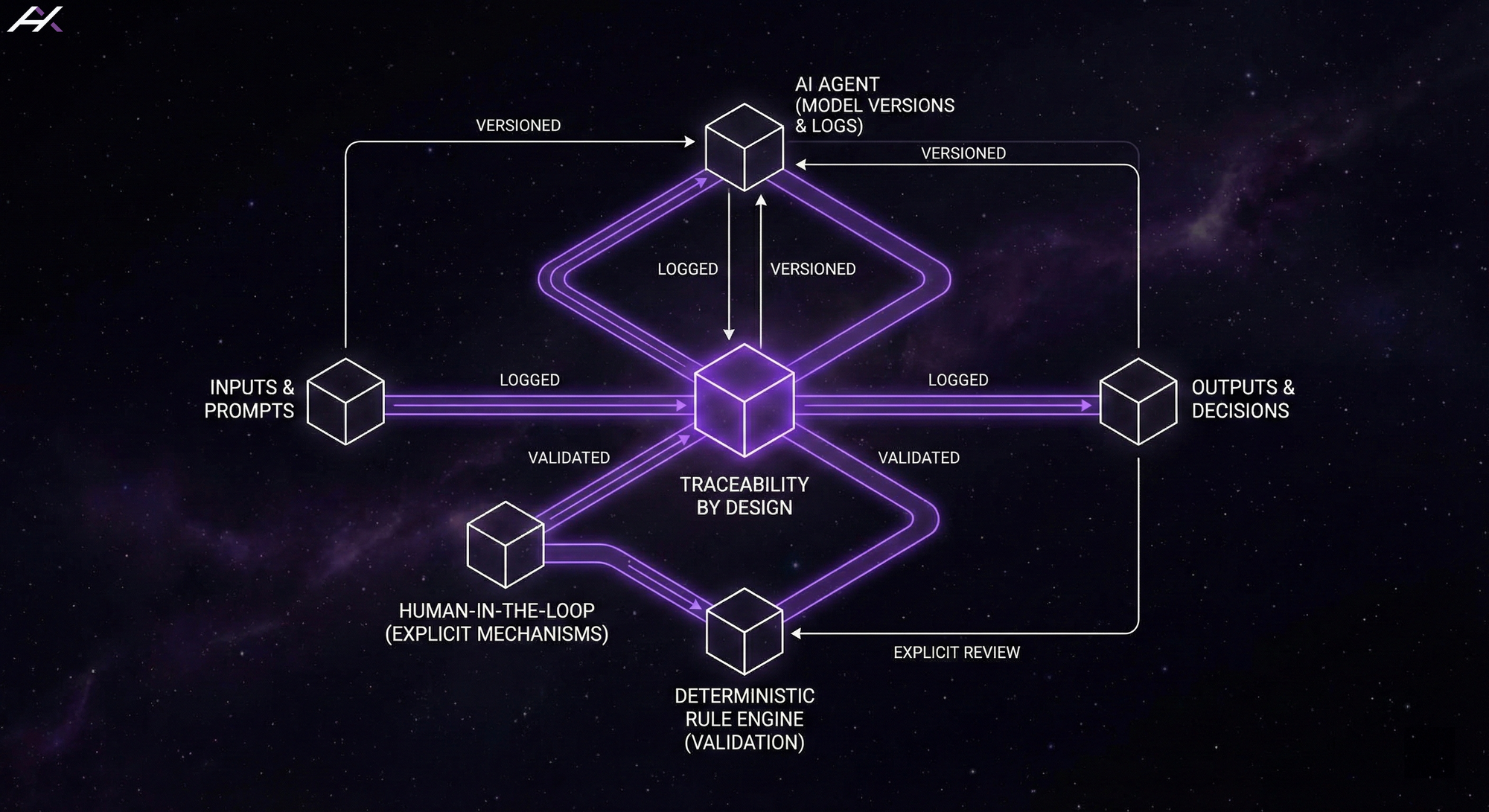
These requirements are not regulatory overhead. They define which systems are eligible for AI integration and which are not.
What actually needs to be cleaned up
The critical insight is that not everything requires modernization. The wrong insight is that nothing does.
First, AI relevance. Systems that will never participate in AI-driven workflows do not need to be optimized for AI consumption.
Second, data quality versus data access. APIs without trustworthy data are as ineffective as high-quality data locked behind inaccessible interfaces.
Third, use-case criticality. Exploratory or internal use cases tolerate uncertainty. Customer-facing or decision-making use cases do not.
The intersection of these dimensions determines where architectural investment is mandatory.
Enterprise Architecture as investment navigator

The objective is not to automate architectural documentation, but to guide investment decisions under AI-driven constraints.
AI readiness becomes a measurable architectural attribute. Systems are assessed for relevance, accessibility, data quality, and compliance exposure. Use cases are prioritized based on business value. Dependencies are mapped explicitly. Gaps become visible and actionable.
Architecture roadmaps are then synchronized with AI initiatives, not treated as parallel efforts. Standards for APIs, data quality, logging, and human oversight prevent the creation of new technical debt under the banner of innovation.
Conclusion: Focus on the right things
The underlying enterprise landscape will not disappear. Legacy applications, integration debt, and undocumented behavior will remain realities for the foreseeable future.
The question is not whether everything must be modernized, but what must be modernized, why, and in which order.
AI agents have concrete technical limitations. These limitations are not negotiable, and they are not evenly distributed across the landscape. Enterprise Architecture provides the structure to navigate this reality.
My content is carefully prepared, crafted and takes anywhere from a few days to several weeks. I sacrifice my free time to create high quality content for you.
The easiest way you can support ♥️ me? Subscribe, like and share this article.
If you like to know more about me, please contact me directly or visit my LinkedIn profile.