The EA Value Cycle: Why closing the circle matters

Enterprise Architecture has a persistent credibility problem. Not because the discipline is conceptually flawed, but because most organizations implement it in a way that separates the feedback connections that would make it useful. The result is an architecture function that produces artifacts — roadmaps, reference models, principle catalogues — without producing measurable outcomes. The EA Value Cycle is an attempt to name what is actually required: not better documentation, but a closed system in which strategy, investment, design, delivery, and measurement reinforce each other continuously.
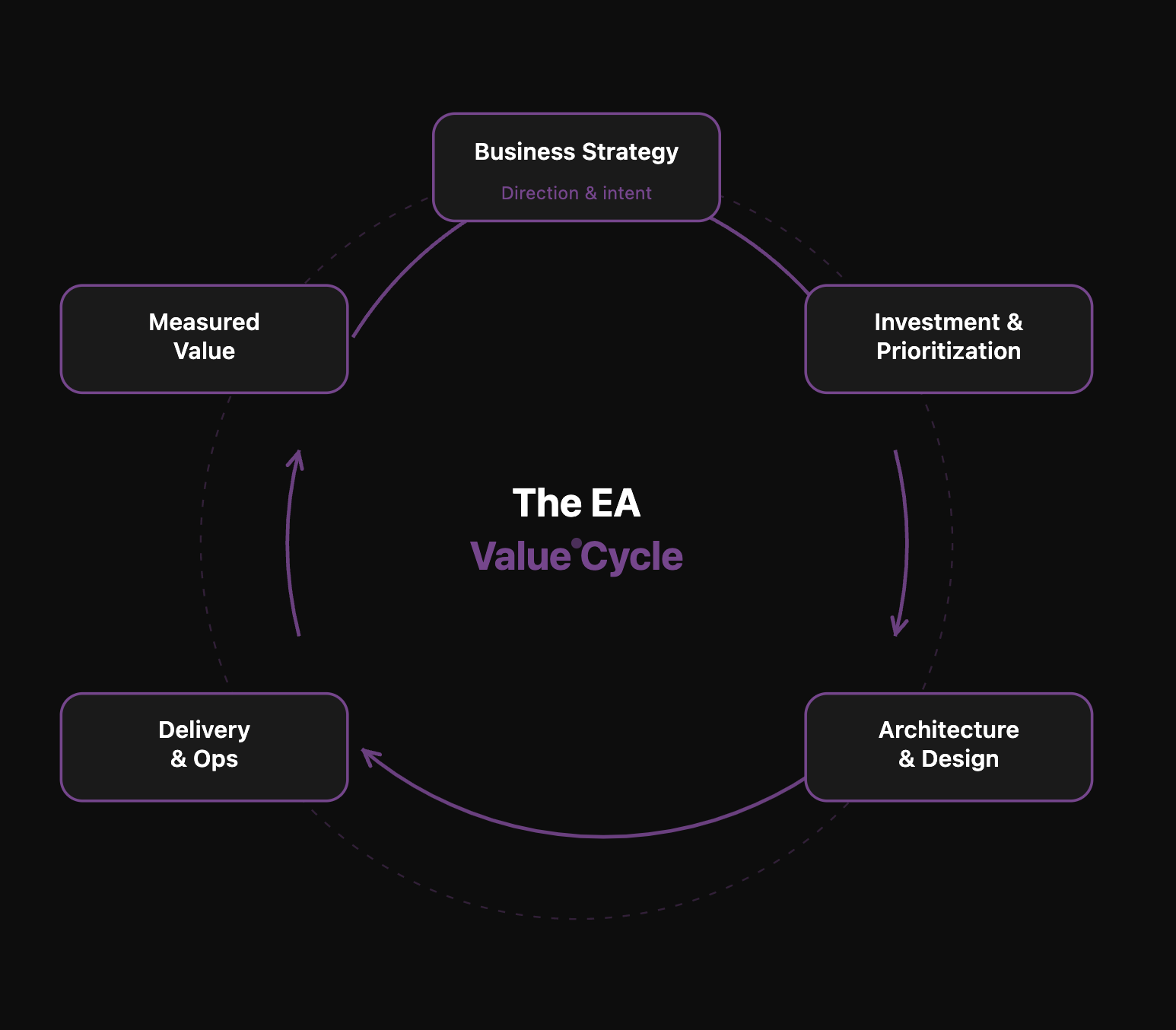
Strategy without architecture is wishful thinking.
Business strategy, in most enterprises, is articulated at a level of abstraction that makes it practically useless for technology decision-making. "Become a platform business" or "enable data-driven operations" are aspirations, not specifications. The architecture function's first obligation is to translate these statements into structural implications: which capabilities are currently absent, which integration points do not yet exist, which data assets are siloed in ways that prevent the stated ambition.
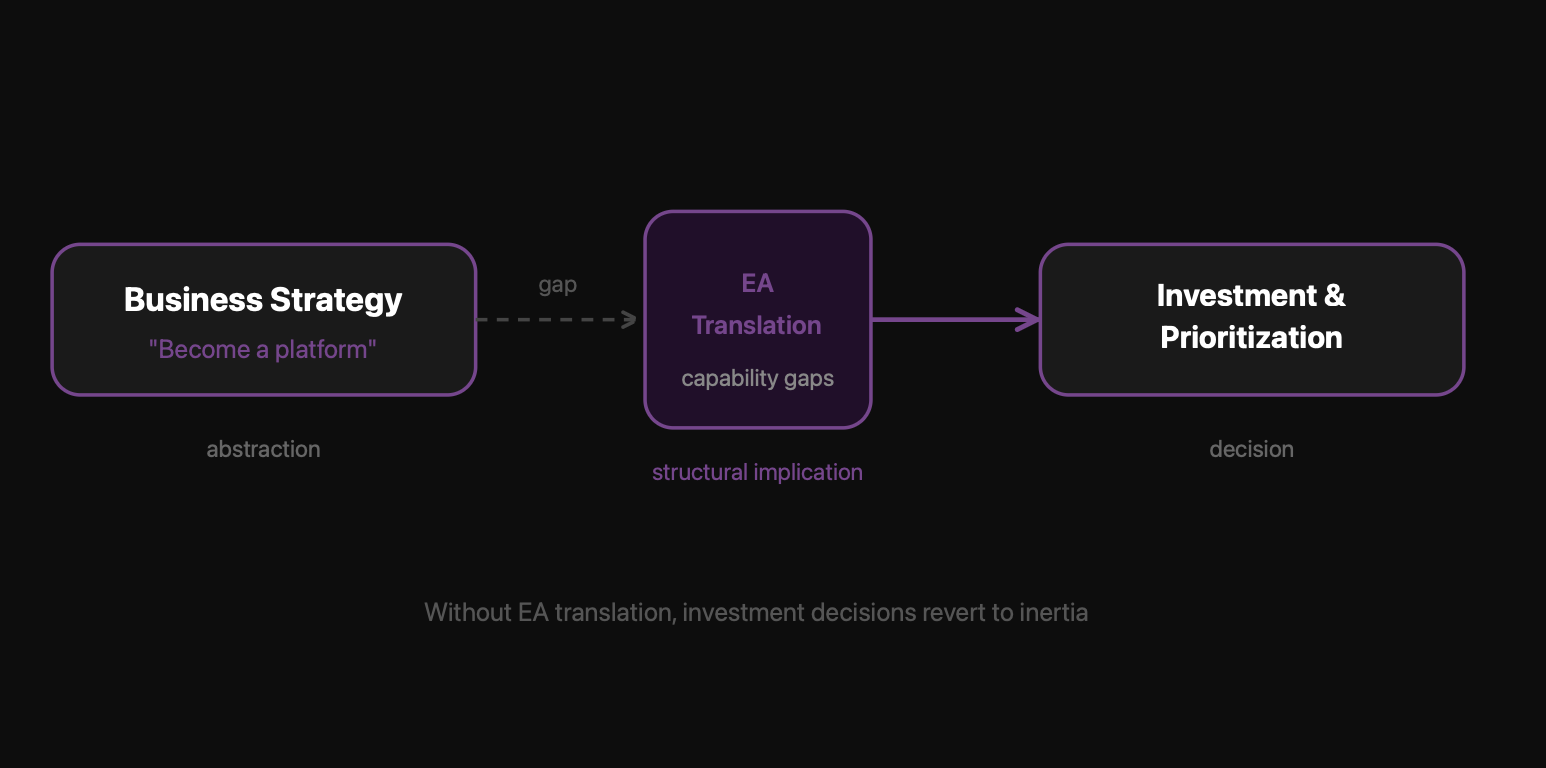
When this translation step is missing — or when EA teams produce capability maps that no one reads — the link between Business Strategy and Investment & Prioritization breaks. The consequence is not neutral. Investment decisions then revert to organizational inertia: existing budget owners defend existing systems, and the technology portfolio drifts further from strategic intent with each planning cycle. The architecture team, observing this drift, documents it. The documentation is filed. Nothing changes.
What the cycle requires at this stage is not more documentation but an architectural position that is explicit enough to be contested. An EA function that cannot say "this proposed investment contradicts our stated direction because it deepens dependency X, which we have committed to eliminate" has no leverage in investment governance.
Investment & Prioritization: Where architecture gets tested.
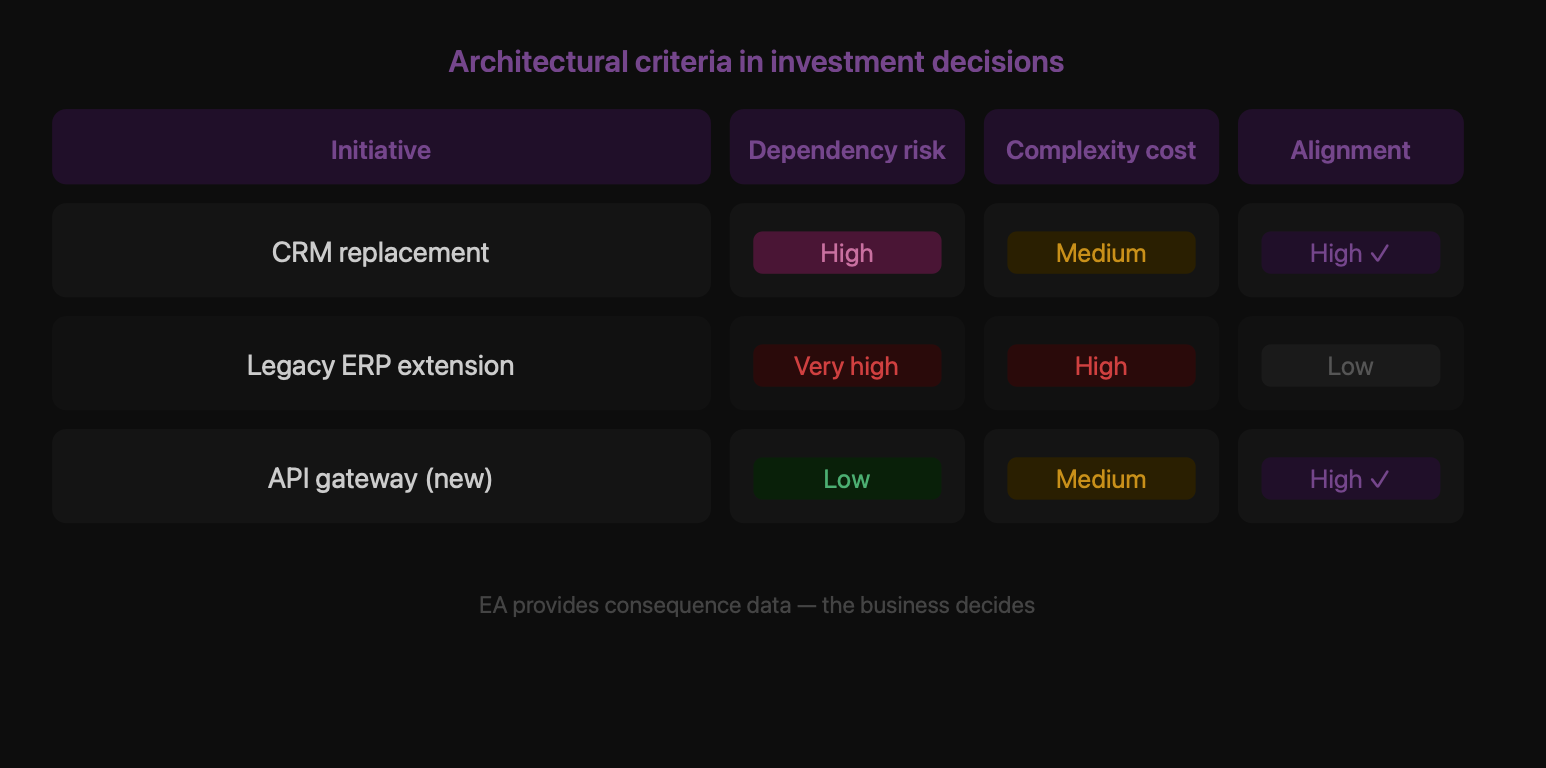
The Investment & Prioritization stage is where enterprise architecture either earns its seat at the table or loses it permanently. Portfolio decisions in large organizations are driven by a combination of regulatory pressure, business unit lobbying, vendor relationships, and whatever happens to be politically salient in the current fiscal year. Architecture can influence this process — but only if it offers something the business cannot produce on its own: a structured view of systemic risk, dependency cost, and long-term complexity accumulation.
This is not the same as saying "EA should approve all investments." That model fails for well-documented reasons: it creates bottlenecks, generates adversarial relationships, and eventually gets bypassed. What works, in practice, is an architecture function that provides decision-relevant information about consequence. Not "you cannot build this," but "if you build this here, in this way, the downstream integration cost is approximately X and the risk of data inconsistency in systems A, B, and C increases materially." Whether the business proceeds is its decision. Whether it proceeds with eyes open is the architecture function's contribution.