Forward Deployed Engineering: An old model under a new name
Few roles have moved as quickly from niche to boardroom vocabulary as the forward deployed engineer. The term comes from Palantir, which embedded engineers with clients to make a generic data platform solve specific operational problems [2]. AI model providers, software vendors and consultancies all use it now [3]. In a recent McKinsey explainer, one of the interviewees, who has done the work for two decades, admits that the label is “maybe a bit of a buzzword” [1]. If the concept is older than the name, the more useful question is why the model is being sold so hard now, and what it means for the organizations that buy it.
What is actually new
Take away the label and the model is familiar: engineers placed at the client, working inside its systems and data, building software together with the people who will use it. Enterprises have bought this for decades as implementation partnering or co-located delivery. What has changed is the product being deployed. Packaged enterprise software came with a defined process model and needed configuration. A large language model comes with almost no process model at all. To produce a working outcome, it has to be combined with a data layer, an understanding of how decisions are actually made in the organization, a control harness that constrains its behavior, and changes to the workflow around it [1]. None of this ships with the model. Most of it cannot be specified upfront, because the knowledge it depends on is tacit.
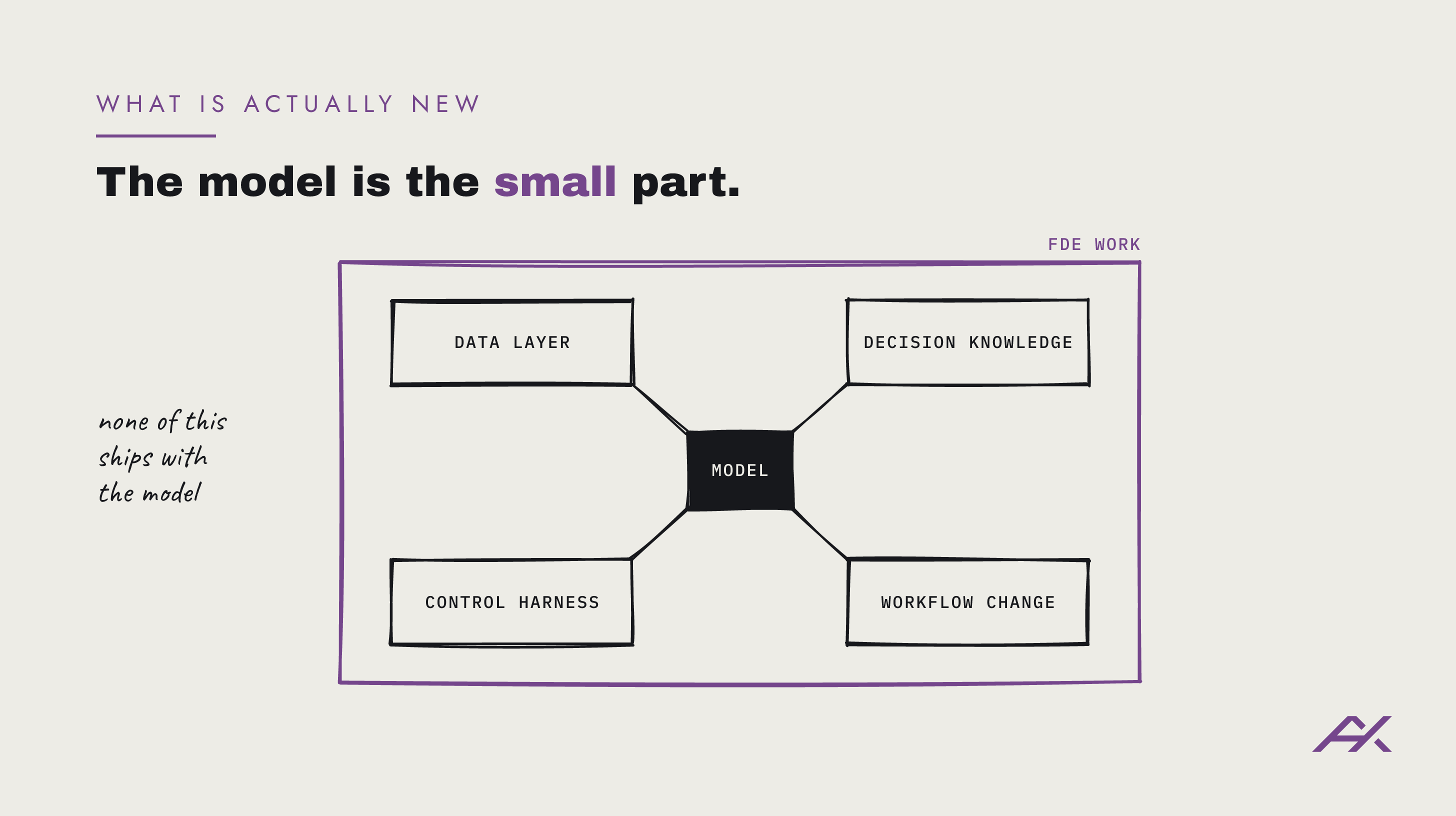
This is the real argument for the FDE model, and it holds. When a requirement cannot be written down before the work starts, a delivery model that discovers the requirement while building suits the problem better than one that waits for a specification. The difficulty lies in what that discovery process leaves behind.
The economics shift rather than disappear
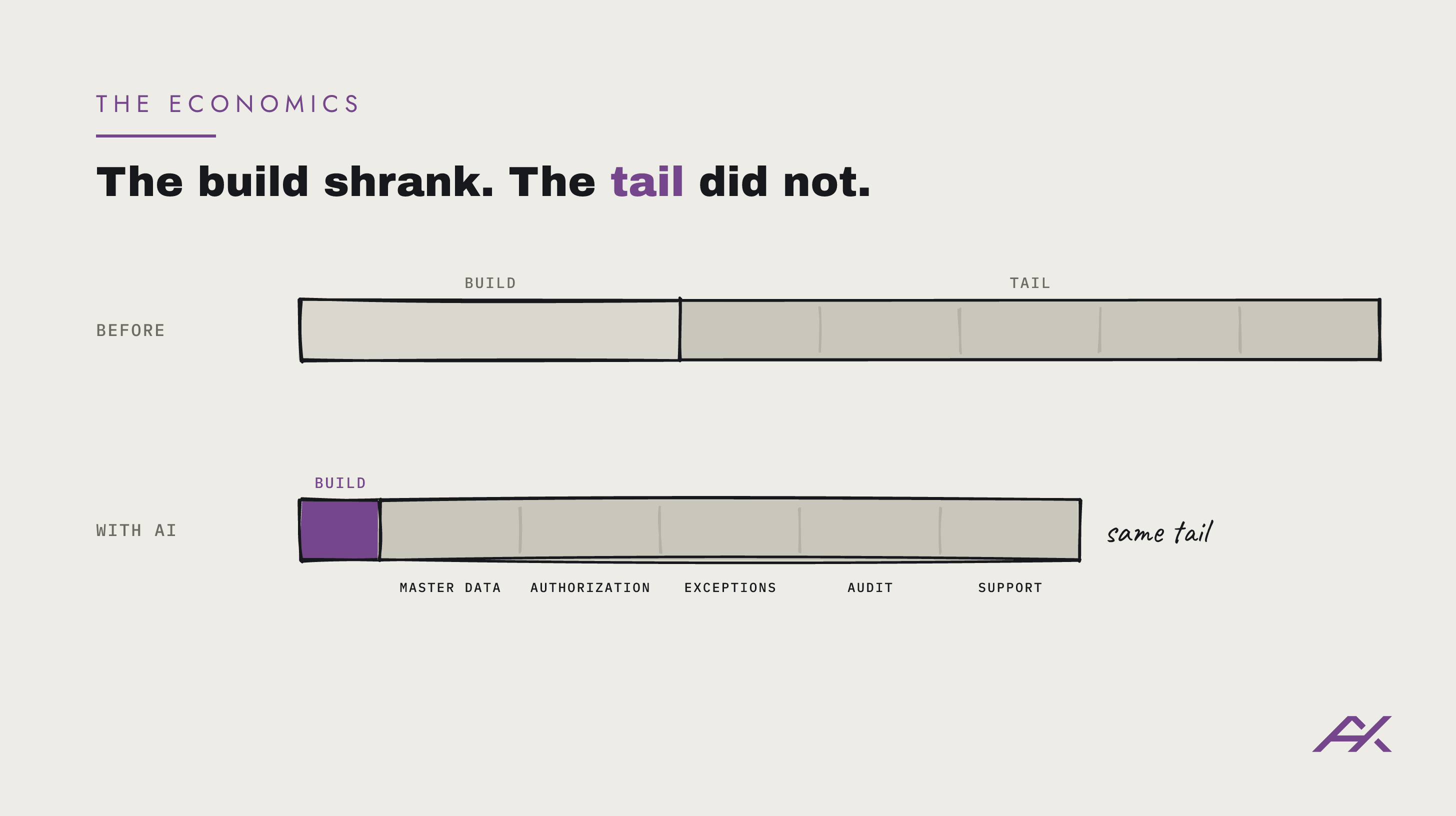
Much of the current enthusiasm rests on speed. The McKinsey interviewees describe a supply chain visibility tool built in about a day and a half, a capability that would previously have taken large teams several years [1]. There is no reason to doubt the prototype. There is good reason to question the comparison, because what took years in the past was rarely the first working version. It was integration with master data, authorization models, exception handling, auditability, support processes and the long tail of edge cases that only appear once a tool is used at scale.
AI shortens the build. It does not shorten that tail by the same factor. The cost structure therefore moves rather than shrinks. At the front end, money that went on licences and specification now goes on scarce, expensive people. At the back end comes an operating burden that is easy to underestimate after a successful demo. An FDE engagement that ends when the tool works has left the more expensive part of the lifecycle with the client. Who pays for running, monitoring and re-validating an agentic system once the engineers who understood it have moved on?
The architectural residue
Each FDE engagement is optimized locally by design. The engineer sits with one team, learns one set of decisions and builds against one problem. That is what makes the model effective, and it is also what makes it risky for the architecture when it is repeated across an enterprise. Consider a typical multinational with several ERP instances, a central data platform still under construction, an identity model that varies by region and a handful of strategic SaaS platforms, each bringing its own AI features. Five parallel FDE engagements in that environment will produce five data extraction routes, five prompt and evaluation harnesses, five interpretations of the same customer or asset entity, and possibly dependencies on three model providers.
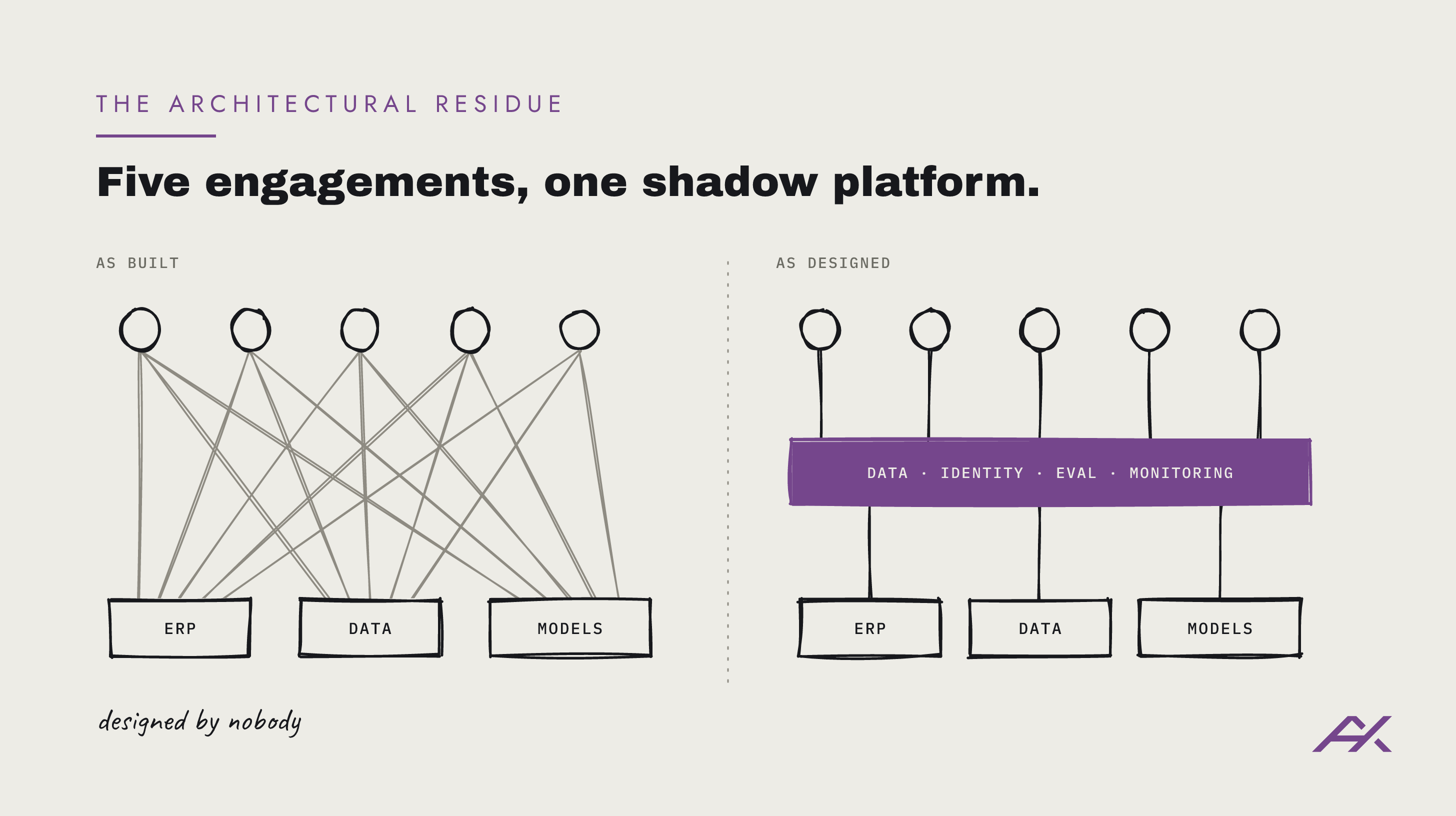
Each of these decisions may be defensible in isolation. Together they form a shadow platform that nobody designed and nobody owns. The pattern has precedent. The same dynamic produced uncontrolled spreadsheet logic and departmental integration layers in earlier decades. The difference now is that the tooling makes building cheap, and so it makes proliferation cheap as well.
A shadow platform that nobody designed and nobody owns.
Incentives and accountability
The neutrality of the FDE also deserves scrutiny, because the parties offering the model have different interests. A model provider’s FDE has a natural incentive to solve the problem with that provider’s models and to increase consumption. A software vendor’s FDE will tend to extend the vendor’s platform. A consultancy’s FDE has an incentive towards continued engagement, and, as one of the McKinsey interviewees notes, the line between FDE and consultant is already fading [1]. None of this is improper. It does mean that the choice between generative AI, machine learning or a simple regression, which one of the McKinsey interviewees rightly frames as a judgment call [1], is often made by someone with a commercial stake in the answer.
Accountability raises a similar issue. Code built inside the client’s systems becomes the client’s code, and the client takes on the model risk, data protection exposure and regulatory obligations that come with it. Where agentic systems act in customer-facing processes, the harness that prevents hallucination or inappropriate behavior is not a delivery detail. It is a control, and controls need an owner who stays.
Where the model fits
Forward deployment is a legitimate and often effective way to get value from AI. Its strengths count most on high-value problems with unclear requirements that depend heavily on tacit operational knowledge, where building is the fastest way to find out what is needed. It fits less well as the default delivery model for AI. It also cannot replace the platform, data and governance foundations that decide whether local successes can be operated and scaled.
The decision in front of leadership
The decision is therefore less about the role itself than about the conditions under which it is used. Before engaging FDEs, an organization should be able to answer five questions:
Which problems genuinely require discovery through building, and which only appear to because the requirement has never been properly defined?
Which shared components, from data access and identity to evaluation and monitoring, must every engagement use, and who provides them?
Who owns the resulting system once the engineers leave, and is its run cost part of the business case?
How is the choice of method and model kept independent of the supplier’s commercial interest?
How much internal capability is needed to judge the work independently?
The answers determine whether forward deployment builds lasting capability or simply piles up unmanaged complexity faster.
Sources and citations
[1] McKinsey & Company, “What is a forward-deployed engineer?”, McKinsey Explainers, video interviews with Holger Hürtgen, Martin Harrysson and Nick Robson. https://www.mckinsey.com/featured-insights/mckinsey-explainers/what-is-a-forward-deployed-engineer. Used for: the quotation “maybe a bit of a buzzword” (Hürtgen); the components needed to make AI work, namely model, data layer, organizational understanding, harness and workflow change (Harrysson); the supply chain tool built in about a day and a half and the converging FDE and consultant roles (Robson); and method choice as a judgment call (Hürtgen).
[2] The Pragmatic Engineer, “Forward Deployed Engineers”. https://newsletter.pragmaticengineer.com/p/forward-deployed-engineers. Used for: the origin of the role at Palantir.
[3] Insight Global, “What is a forward deployed engineer?”. https://insightglobal.com/blog/what-is-a-forward-deployed-engineer/. Used for: AI model providers such as OpenAI, Anthropic and Cohere investing in forward deployed teams.
My content is carefully prepared, crafted and takes anywhere from a few days to several weeks. I sacrifice my free time to create high quality content for you.
The easiest way you can support ♥️ me? Subscribe, like and share this article.
If you like to know more about me, please contact me directly or visit my LinkedIn profile.