

Enterprise Architecture has a persistent credibility problem. Not because the discipline is conceptually flawed, but because most organizations implement it in a way that separates the feedback connections that would make it useful. The result is an architecture function that produces artifacts — roadmaps, reference models, principle catalogues — without producing measurable outcomes. The EA Value Cycle is an attempt to name what is actually required: not better documentation, but a closed system in which strategy, investment, design, delivery, and measurement reinforce each other continuously.
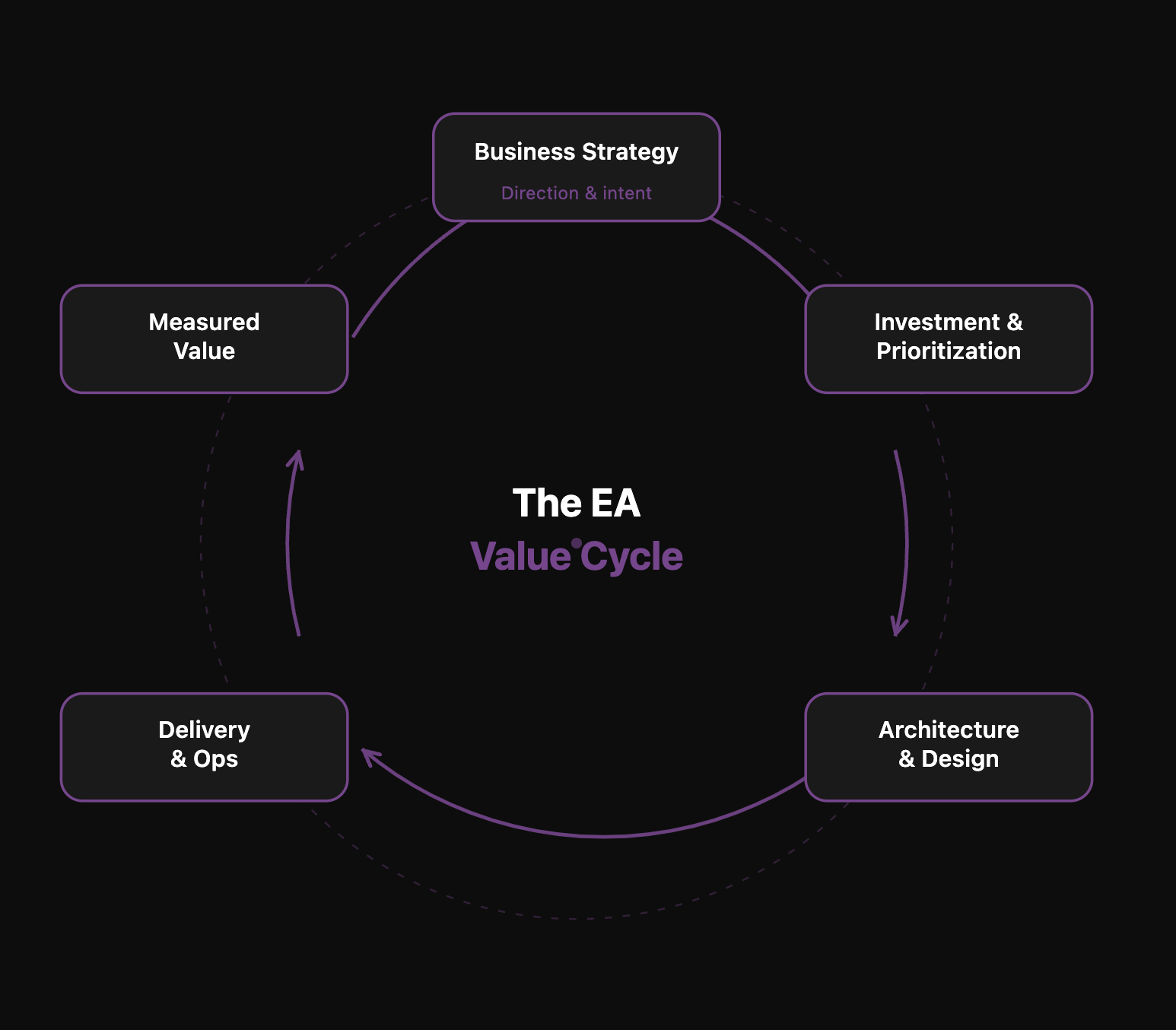
Strategy without architecture is wishful thinking.
Business strategy, in most enterprises, is articulated at a level of abstraction that makes it practically useless for technology decision-making. "Become a platform business" or "enable data-driven operations" are aspirations, not specifications. The architecture function's first obligation is to translate these statements into structural implications: which capabilities are currently absent, which integration points do not yet exist, which data assets are siloed in ways that prevent the stated ambition.
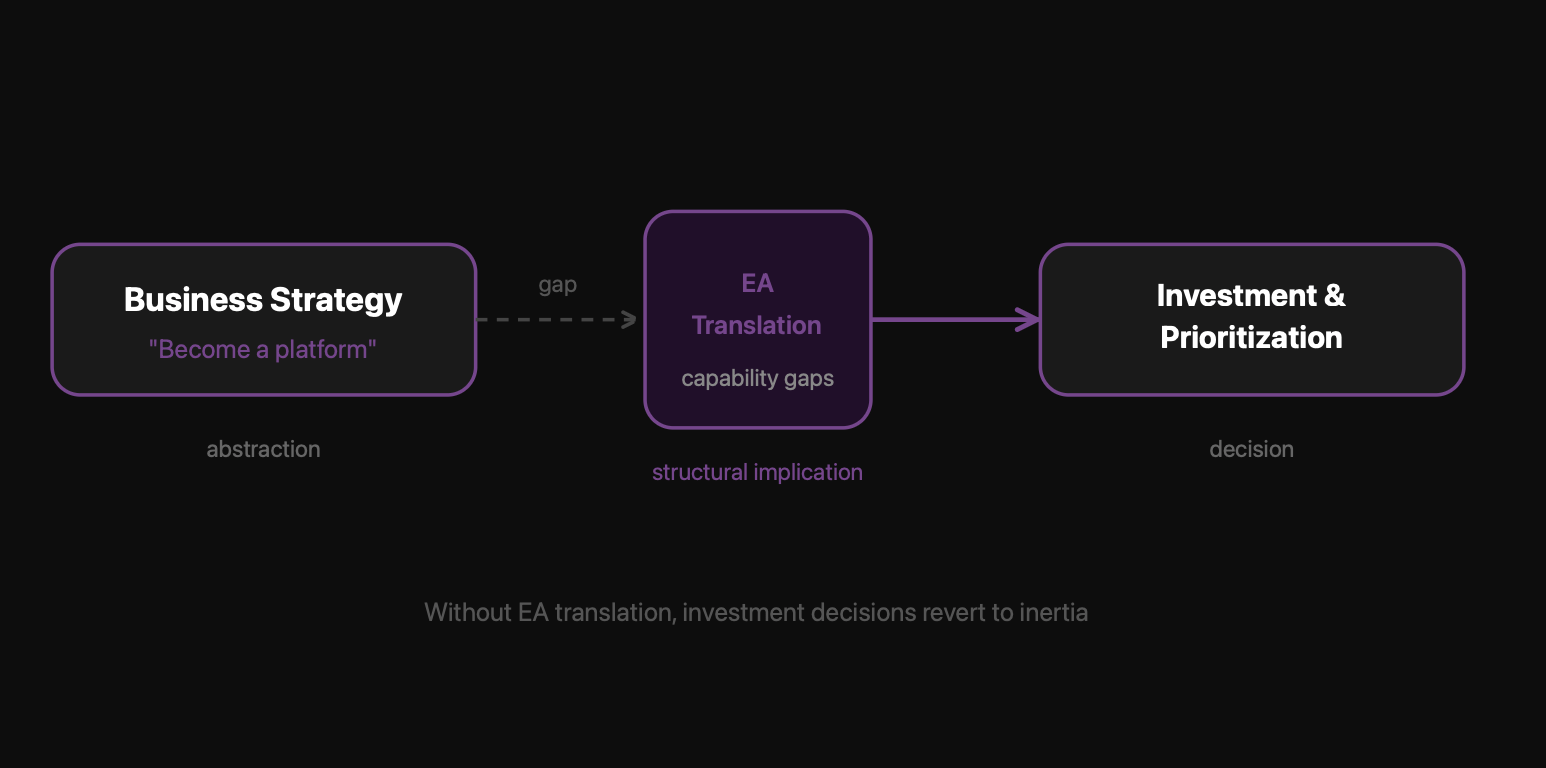
When this translation step is missing — or when EA teams produce capability maps that no one reads — the link between Business Strategy and Investment & Prioritization breaks. The consequence is not neutral. Investment decisions then revert to organizational inertia: existing budget owners defend existing systems, and the technology portfolio drifts further from strategic intent with each planning cycle. The architecture team, observing this drift, documents it. The documentation is filed. Nothing changes.
What the cycle requires at this stage is not more documentation but an architectural position that is explicit enough to be contested. An EA function that cannot say "this proposed investment contradicts our stated direction because it deepens dependency X, which we have committed to eliminate" has no leverage in investment governance.
Investment & Prioritization: Where architecture gets tested.
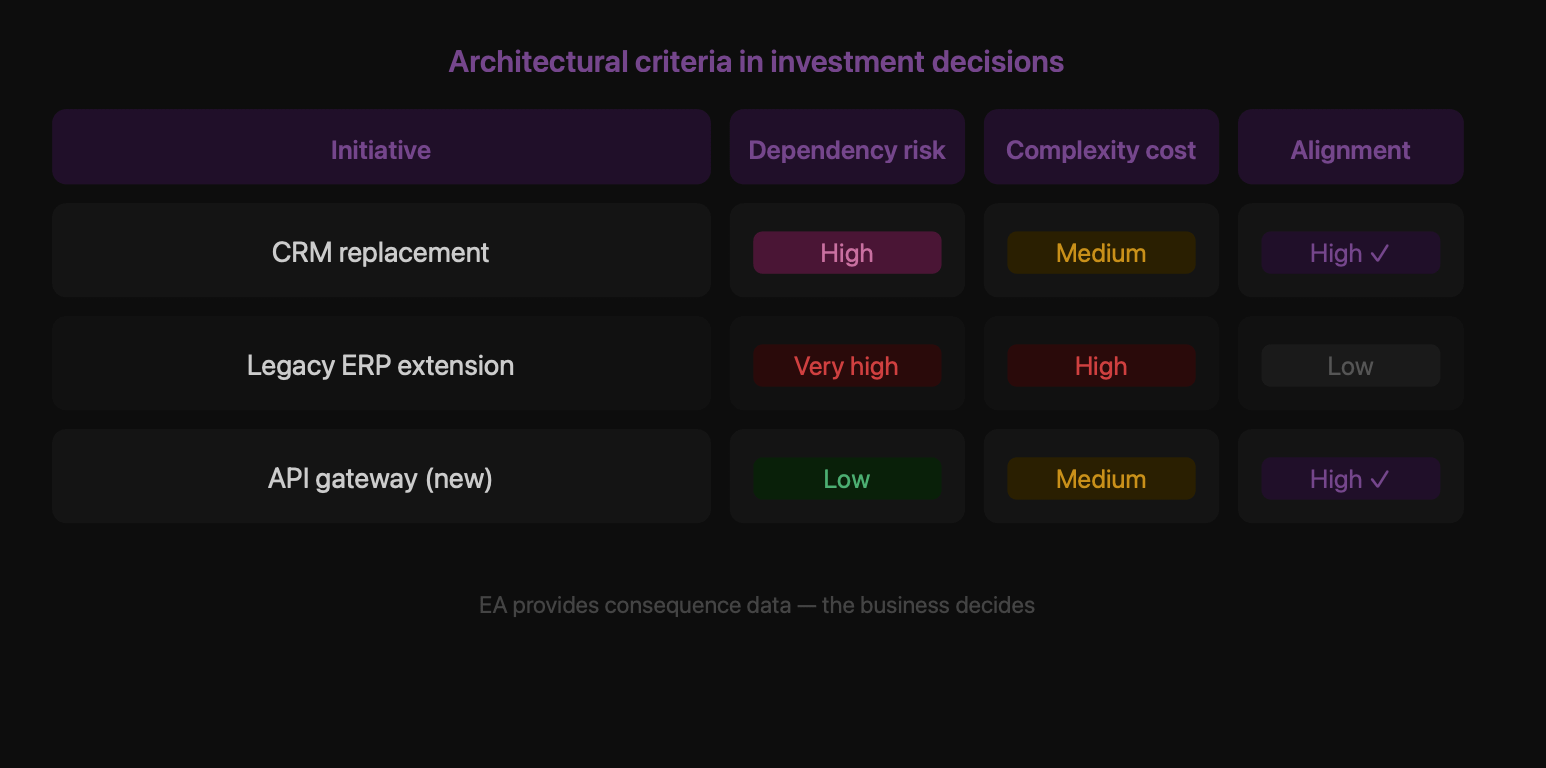
The Investment & Prioritization stage is where enterprise architecture either earns its seat at the table or loses it permanently. Portfolio decisions in large organizations are driven by a combination of regulatory pressure, business unit lobbying, vendor relationships, and whatever happens to be politically salient in the current fiscal year. Architecture can influence this process — but only if it offers something the business cannot produce on its own: a structured view of systemic risk, dependency cost, and long-term complexity accumulation.
This is not the same as saying "EA should approve all investments." That model fails for well-documented reasons: it creates bottlenecks, generates adversarial relationships, and eventually gets bypassed. What works, in practice, is an architecture function that provides decision-relevant information about consequence. Not "you cannot build this," but "if you build this here, in this way, the downstream integration cost is approximately X and the risk of data inconsistency in systems A, B, and C increases materially." Whether the business proceeds is its decision. Whether it proceeds with eyes open is the architecture function's contribution.
The critical failure mode at this stage is an EA team that provides architectural input after investment decisions have already been made. Retrospective compliance review is not governance. It is administrative overhead dressed as governance.
Architecture & Design: From principle to constraint.
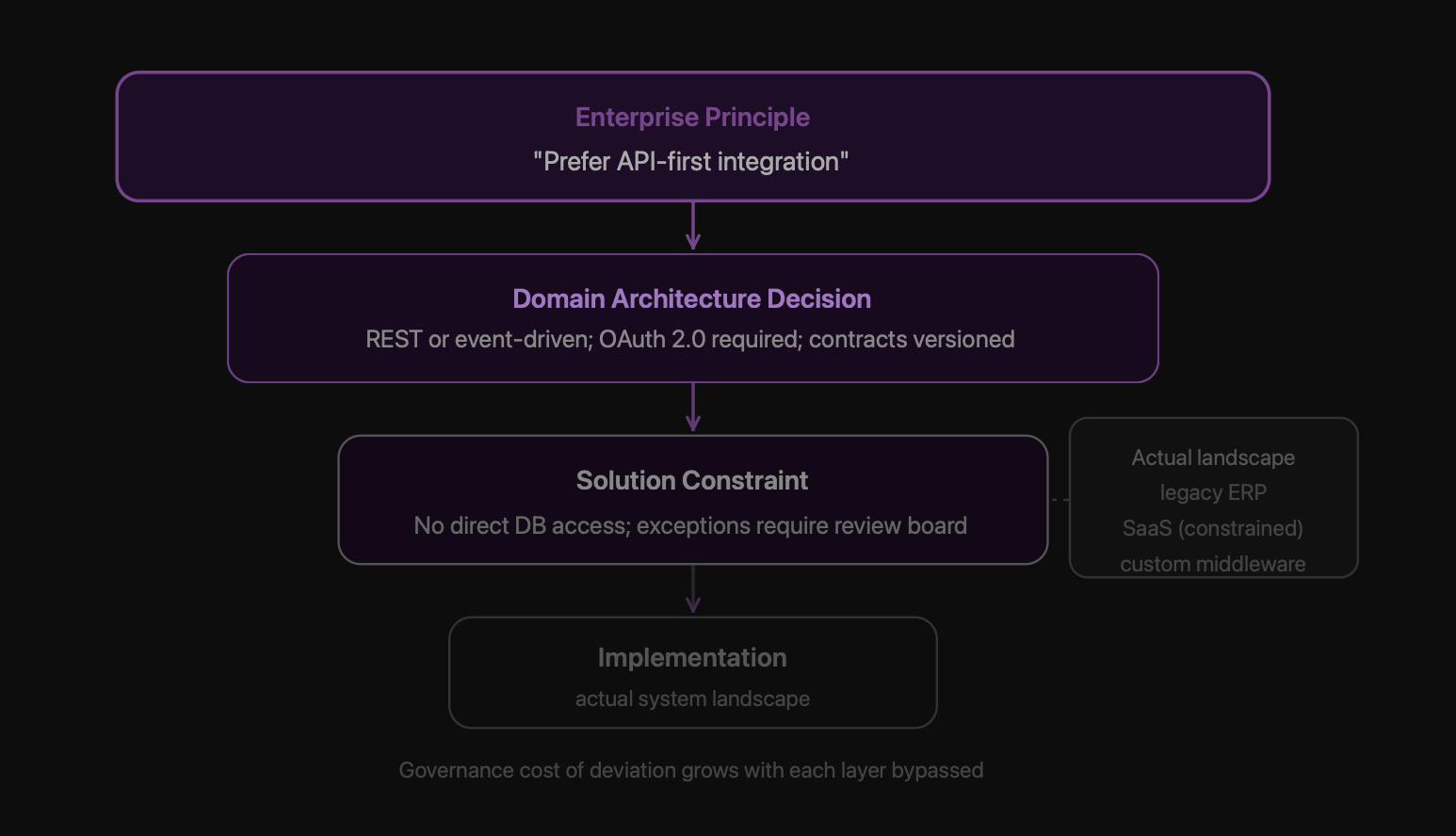
Architecture & Design is where abstract principle meets concrete system reality, and where most enterprise architecture frameworks quietly collapse. A principle that states "prefer API-first integration" is not an architectural decision — it is an aspiration. An architectural decision specifies which integration patterns are permitted in which contexts, which authentication mechanisms are required, which data contracts must be versioned and how, and which deviations require explicit exception approval.
The discipline required here is precision, not creativity. Enterprise system landscapes are rarely greenfield. They contain a mixture of legacy platforms with undocumented integration dependencies, SaaS products with constrained extensibility, custom-built components that have drifted from their original specifications, and a layer of middleware that was itself supposed to be temporary fifteen years ago. Architecture decisions that ignore this reality do not govern the landscape — they coexist with it, decoratively.
Effective architecture at the design stage means maintaining a current and accurate model of the existing landscape — not a conceptual target state, but the actual state - and using it to constrain solution design before implementation begins. The cost of an architectural violation discovered during delivery is an order of magnitude higher than the cost of a design review. This is not a philosophical position; it is a project budget observation that can be verified empirically in most large program post-mortems.
Delivery & Ops: Where reality diverges from intent.
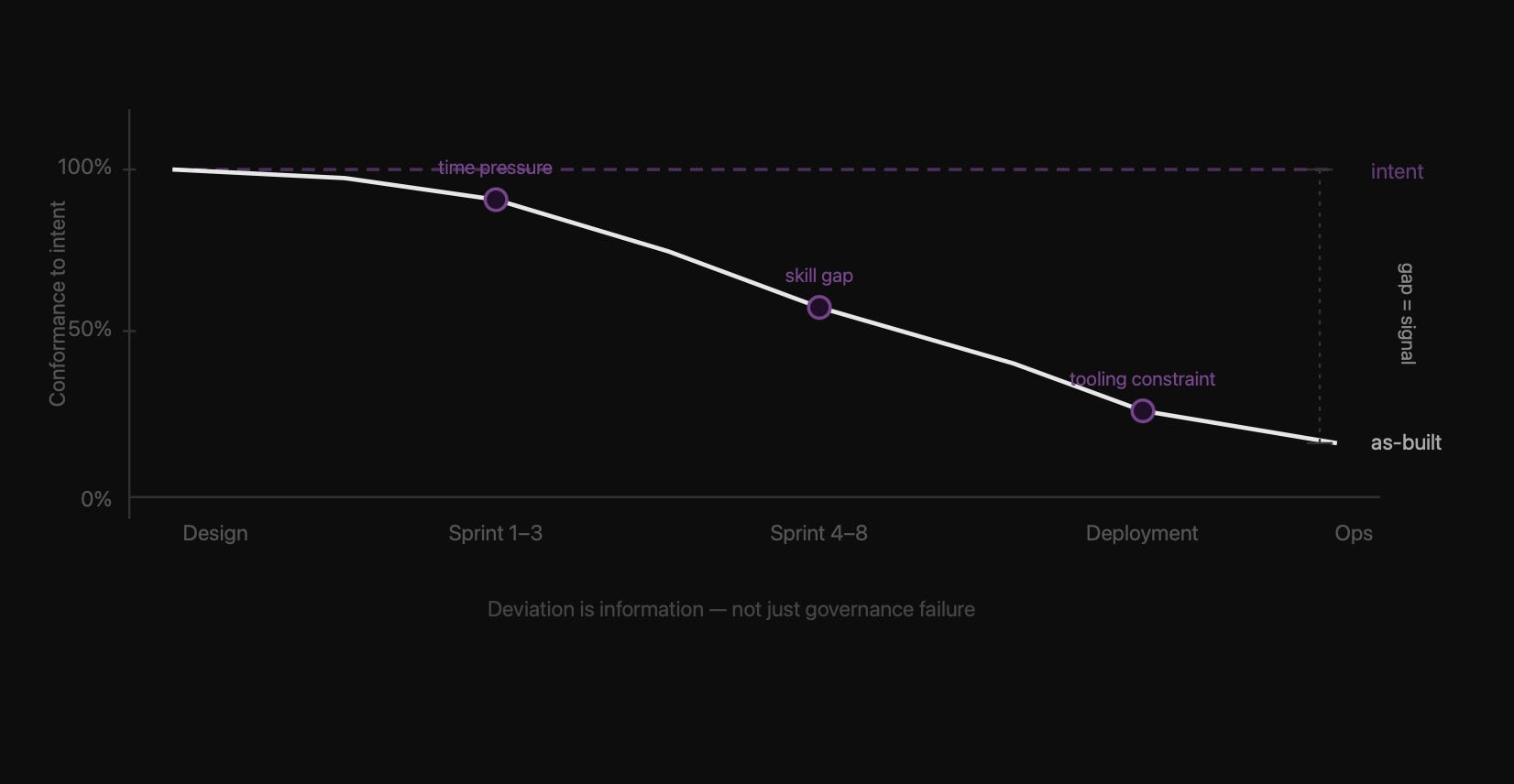
Delivery & Ops is where the EA Value Cycle most commonly breaks down in practice, and the break is structural rather than accidental. Architecture teams produce designs; delivery teams implement them under time pressure, with incomplete information, using the tools and skills actually available rather than the tools and skills assumed in the architectural model. The result is an as-built state that diverges from the intended design in ways that are individually defensible and collectively significant.
The architecture function has two choices when confronting this divergence. It can treat every deviation as a governance failure, which produces a compliance posture that delivery teams learn to route around. Or it can treat deviation as signal information about where the architectural model was unrealistic, where tooling is insufficient, where team capability requires investment, or where the design itself contained assumptions that did not survive contact with operational constraints.
The second approach requires humility, but it also requires instrumentation. An architecture team that has no visibility into what is actually deployed cannot learn from the gap between intent and reality. This is why the connection between Delivery & Ops and Measured Value is not cosmetic — it is the mechanism by which the cycle either closes or remains permanently open.
Measured Value: The condition that makes everything else credible
Measured Value is the stage that most EA programs either skip entirely or implement as a retrospective satisfaction survey. Neither approach closes the cycle. What is required is a measurement framework that connects architectural decisions — made at the Investment & Prioritization and Architecture & Design stages — to outcomes that are observable in the Delivery & Ops stage and meaningful at the Business Strategy level.
This is technically harder than it sounds. Architectural quality is not directly observable in the way that revenue or system uptime is. It manifests in proxy indicators: the time required to integrate a new capability into the existing landscape, the frequency and blast radius of incidents that cross domain boundaries, the cost of change in systems that were designed for flexibility versus those that were not. Building the instrumentation to capture these indicators requires investment, organizational agreement on definitions, and a willingness to report numbers that may be unflattering to current architecture decisions.
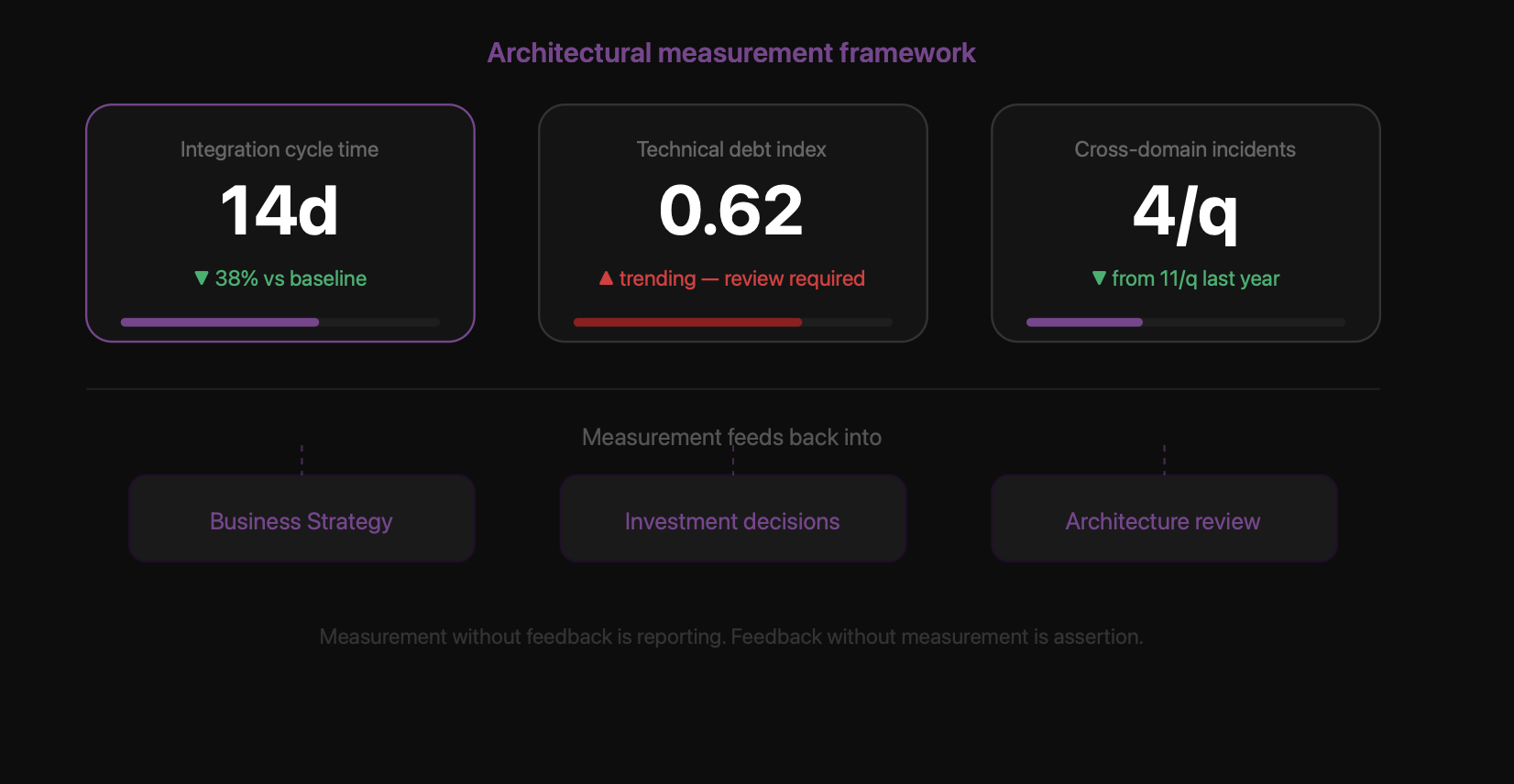
The return on that investment, however, is substantial. An EA function that can demonstrate that architectural governance decisions reduced integration cost by a quantifiable amount, or that systems designed to a defined standard exhibited measurably lower incident rates, is an EA function that can make a credible case for continued investment. More importantly, it is an EA function that can feed measured reality back into Business Strategy discussions, closing the cycle with evidence rather than assertion.
The Cycle as governance model, not process chart.
The EA Value Cycle is most usefully understood not as a process flow — a sequence of stages through which work passes — but as a description of the information dependencies that must be maintained for enterprise architecture to function as a governance discipline rather than a documentation exercise. Each stage depends on outputs from the previous stage and produces inputs for the next. When any connection is severed, the cycle degrades into a set of disconnected activities that each consume organizational energy without reinforcing each other.
The practical question for any EA function is not "do we do all five of these things?" but "are the connections intact?" Does architectural input actually shape investment decisions, or does it arrive after the fact? Does design intent actually constrain delivery, or does delivery produce a fait accompli that architecture retrospectively blesses? Does measurement actually feed back into strategy, or does it disappear into a quarterly report that no one acts on?
Answering those questions honestly is, in most organizations, more useful than any framework adoption or tooling investment. The cycle either closes or it does not. If it does not, the value that enterprise architecture could deliver remains theoretical — well-described in the methodology, invisible in the P&L.
My content is carefully prepared, crafted and takes anywhere from a few days to several weeks. I sacrifice my free time to create high quality content for you.
The easiest way you can support ♥️ me? Subscribe, like and share this article.
If you like to know more about me, please contact me directly or visit my LinkedIn profile.